Shannon McClendon Announces Campaign for Texas Senate (SD-25)
Five-time Governor Rick Perry Appointee, Fiscal Conservative, Property Rights Advocate, Pro-Business Supporter, and 2nd Amendment Patron
Seeks Republican Nomination for Texas Senate District 25
Shannon McClendon
Hays County – Hays County attorney and property owner Shannon McClendon today announces her campaign for the Republican nomination in Texas Senate District 25.
“I am passionate about limited government and individual responsibility to allow our economy to thrive,” said McClendon. “My law practice includes protecting private property rights. I am fiscally conservative and will be a fierce advocate for reducing taxes for the health of our economy and stopping government intrusion into our personal lives.
“District 25 is not merely where I live, but where I have made a life for close to two decades. I would be honored to represent the views and values of my neighbors in the Texas Senate,” said McClendon.
Shannon says, “As a fourth generation Texan, I am confident in Texans working together to make the best Texas ever. We are very fortunate that Hurricane Harvey did not directly impact the residents and businesses of SD 25 as it was forecasted to do. So now is the time, and I am motivated to work together to plan to minimize the impacts of floods and droughts, and ensure the economic prosperity of District 25 by helping bring businesses and create jobs in our area.”
Shannon McClendon primarily practices energy law. As part of her law practice, she represents landowners, homeowners, ranchers, and farmers to protect their property rights in transmission line routing cases. A founding partner in Webking McClendon, PC, McClendon was also a partner at Gardere Wynne Sewell, LP. Prior to earning her Doctorate of Jurisprudence from the University of Houston Law Center, she was a computer systems analyst with Texas Instruments and the Space Transportation Shuttle Operations (STSOC) at NASA.
McClendon was part of the first generation of young women to join the Fightin’ Texas Aggie Corps of Cadets. After leaving A&M to pursue career opportunities in the emerging field of computer science, she finished her undergraduate studies at the University of Houston in Clear Lake, graduating magna cum laude with a Bachelor of Science in American Jurisprudence.
McClendon has an extensive record of trusted public service, having served as a board member of several state agencies. She was appointed by former Governor Rick Perry twice to the Texas Board of Professional Engineers, twice to the Texas Appraisers Licensing and Certification Board, and to the Texas Board of Speech-Language Pathology and Audiology, where she also served under Governor Greg Abbott.
“I know the power of government and the importance of limiting its reach into our lives,” says McClendon. “We need to keep government out of our bathrooms, bedrooms, and company boardrooms, and return the focus to our classrooms.
“Government should do a few things well, and otherwise stay out of our lives and quit wasting taxpayer money.
“Let’s empower our youngest generation with the tools of self-sufficiency, developing their potential through education. Let’s build needed infrastructure, planning and protecting our Hill Country communities from floods and droughts, making our roadways safer and more efficient, and providing the necessary energy to power our lives.
“Let’s preserve law and order, keeping our communities safe from the trafficking of drugs and people by securing the border. And let’s increase punishments for the criminal sex trafficking trade that exploits and abuses women and children.”
McClendon serves, or has served, on a number of organizational boards, including: the Texas Business Hall of Fame (Emeritus), the University of Houston Alumni Association, and the Electric Reliability Council of Texas (ERCOT). She is a member of the State Bar of Texas, the Gulf Coast Power Association, the Texas Federation of Republican Women, the NRA (life member), and the Texas State Rifle Association (life member).
Shannon, and her wife, Cathy Webking, have been together for more than nineteen (19) years. They live on a ranchette in Hays County with their German Shepherd Dog, Stella, and two Ragamuffin cats, Titos and Lucchese. The couple takes great pride in being stewards of God’s land. Both Shannon and Cathy are active members of the Presbyterian Church (USA) of Lake Travis.
Via Bill King’s email update. To subscribe, click here.
Reform TIRZs, Don’t Repeal Property Tax Cap
My former colleagues at the Houston Chronicle editorial board opined this week that the City’s property tax cap should be repealed and that the tax increment reinvestment zones (TIRZs) need to be reformed. [Click here to read.] They are wrong on the first count but right on the second one.
To begin, let’s get some facts straight that were mangled in the editorial.
First, the City does not have a revenue cap; it has a property tax cap. Property taxes make up about 25% of the City’s total revenue. That is the only source of revenue that is limited under the City charter amendment that was approved by voters in 2004. The other 75% of revenue is not restricted. There is a cap on all revenues in the charter that was also approved by the voters in 2004, but because the property tax cap got more votes, the City only enforces the property tax cap.
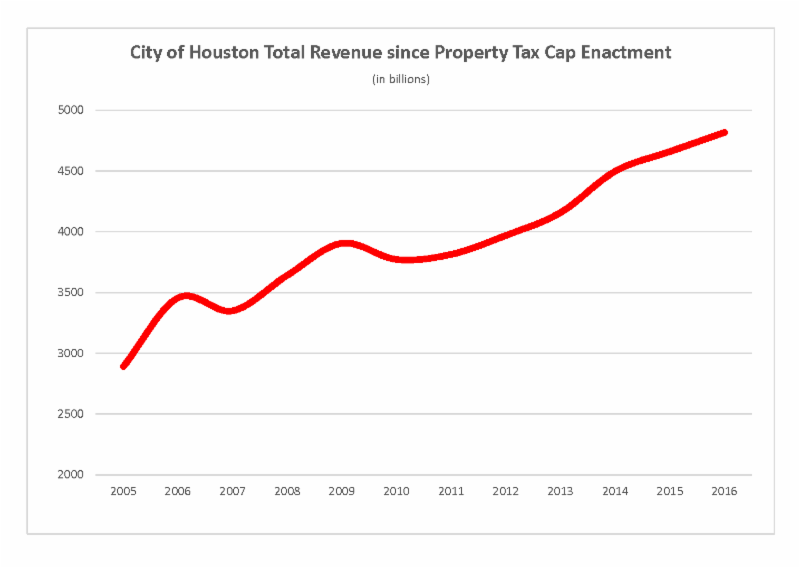
Repeal advocates insist on mischaracterizing the limitation as a “revenue” cap to mislead the public into believing that the City’s ability to raise any form of revenue is impaired by the restriction. But since the charter amendment was enacted, City revenues have increased by a whopping $2 billion (67%), including the enactment of the drainage fee, which was the largest single tax increase in the City’s history.
Second, the increase in taxes is not “constrained by an arbitrary algorithm.” The limit is the lesser of population growth and inflation or 4.5%. Limiting Council’s ability to increase property taxes to population growth and inflation is a reasonable limitation and should be a rough estimate of the need to increase taxes. If the City’s population and inflation were growing by more than 4.5%, I would have to agree that the limitation is arbitrary. But because the City’s population has been growing at a very slow pace and inflation has been low since 2004, the 4.5% limitation normally does not come into play.
Third, and most importantly, the property tax cap repeal advocates always omit that the charter amendment begins with this clause: “The City Council shall not, without voter approval . . .” In other words, in any year that the Mayor and Council believe that the City needs more tax revenue than the limitation allows, all they need to do is ask for the voters’ approval. If they feel handcuffed by the charter amendment it can only be because they believe they cannot make a credible case to the taxpayers to pay more.
My former colleagues are right about the detrimental effect the TIRZs are having on the City’s finances. Last year, the TIRZs collected $132 million in property taxes, nearly 14% of the City’s total property taxes. That is more money than the drainage fee brought in last year.
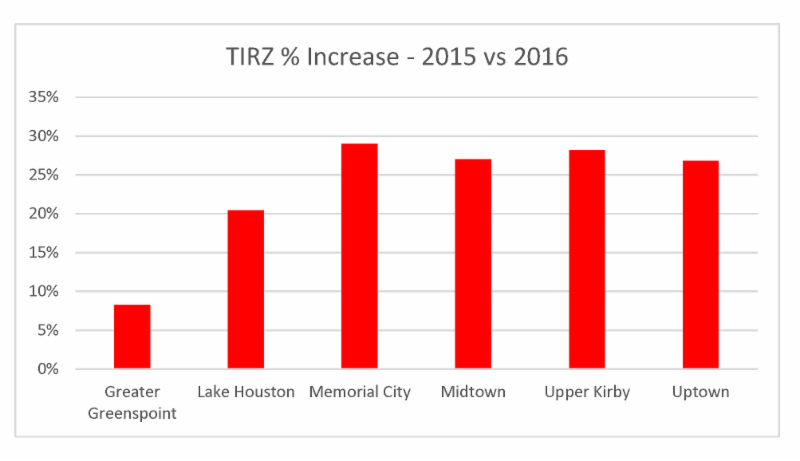
They are also correct that the taxes collected by the TIRZs are excluded from the property tax cap. As a result, TIRZ tax receipts have soared. Last year the property taxes collected by all TIRZs increased 13%. The receipts for the six richest TIRZs went up by an astonishing 27%!
Of course, the City has devised a number of clever ways to claw back more and more of this revenue over time and subvert the voters’ intention as expressed in the cap. Each TIRZ pays the City an administrative fee and most make other contributions toward “shared” expenses. But there is no question that if the City had all of this revenue back, it would go a long way toward solving its long-term structural deficit.
One of the challenges in bringing any of this revenue back to the City is that the TIRZs have been on a debt binge in recent years. They currently owe around half a billion dollars. So, much of their revenue is committed to repaying that debt. Of course, voters had no say in the creation of this debt, notwithstanding that property taxes will be used to repay it.
There are certainly some good projects that are undertaken by the TIRZs. But increasingly they are grasping for projects on which to spend their largess; witness the idiotic $200 million bus lane project in Uptown.
Of course, our benevolent State Legislature has its finger in all of this. All of the TIRZs were created by state statute. So, the State will have to be involved in any restructuring. Given numerous conflicts of interests between our local delegation and the TIRZs and their first cousins, the management districts, good luck with that.
I say probably because tonight I talked to potential challenger Chris Carmona. Chris has filed a treasurer appointment to challenge Simpson. When I asked him tonight why, he said that it was so that he could ‘explore’ the possibility of challenging Simpson. He did not want to commit to running against Simpson at this time, saying only that he was ‘exploring’ the possibility.
When I asked Carmona if he could publicly identify one reason to run against Simpson, he responded that he doesn’t think that Simpson listens to the grassroots and that in his opinion, the little guy isn’t being listened to.
So there you have it. Chris could be a formidable challenger to Paul, no question about it. Should he run, he will have the endorsement of the ‘slates’ of Hotze/Lowry/Polland. And Paul will have the money of the business community.
Some of the people I talked to say that Hotze/Lowry/Polland are ‘playing’ Chris and that they have someone else in mind. Chris said if that is true, he didn’t know anything about it.
Wendy Davis, the former Texas state senator known more for filibustering than governing, is back in the news. And her comments on potential gubernatorial candidate Andrew White show how extreme the Democratic Party has become.
‘it would take a lobotomy’
Apparently reporters still think that she is relevant in Texas and continue to bring up her name as a potential candidate against Gov. Abbott next year, even though he trounced her by 20+ points in 2014. Peggy Fikac reports that Davis ‘slammed the door’ on a 2018 run for governor, saying that ‘it would take a lobotomy’ for her to run. Frankly, many of us think she already had one.
Andrew White, the son of former Gov. Mark White, is exploring a run for governor in the Democratic primary.
I’m Andrew White. I’m an entrepreneur, and I’ve started six businesses. I think we should run our state more like a business, putting customer needs first, while managing the bottom line. Math and data can guide us to make better decisions. Common sense and decency will solve just about everything else.
It’s easy to create division. It takes a leader to build consensus. Let’s take a 4-year break from what divides us and come together as Texans to restore our state’s leadership in jobs, education, and prosperity.
I’ve made a bunch of friends – Democrats, Republicans, Libertarians, and Independents. I’m running as a Democrat, but I agree with Republicans and Libertarians on some issues, Independents on others, and Democrats on many.
Let’s forget the labels. I’ll work everyday with all parties to make real progress. All credit will go to the Legislators who do right and risk consequences. I’ll take the blame for failures.
I want people from other states to wish they lived here. I want Texas to win in everything. Education. Jobs. Self-driving cars… (that can fly!)
Here is what Wendy Davis thinks about his possible campaign:
If you have Facebook, you should click on the picture and read the comments. The very first one says ‘Andrew White is a POS’. Lovely bunch, those Democrats.
Mr. White also said this on Twitter:
Like most Texans, my abortion views don’t fit into one word descriptions. “Us versus Them” works for football, but not women’s health. Let’s stop the game and start making progress. https://t.co/r7Q6zF9Smrhttps://t.co/vRV69JWN9e
More interesting is why he is considered anti-choice. This is from the Women’t Health page on his website:
Roe v Wade is the established law of the land, and has been for decades, and I respect the law. Personally, I can’t understand when a human life actually begins. It’s a mystery known only to God, and, as such my faith tells me to protect the beginning of life. As Governor, that means working on policies to:
Reduce the demand for abortions through education and access to contraceptives
Increase access to pre-natal care
Reduce death due to complications during pregnancy and delivery
Reduce infant mortality
Do I respect the rights of the mother? You bet I do. Do I respect that a woman’s body is private? Absolutely. So, does this mean at times my own views conflict with each other? Yes.
….
Reasonable people want fewer abortions and better health care. There’s common ground here. We should be loving expectant mothers with acts of kindness, while respecting their legal right to choose.
Soon, I’ll be meeting with organizations devoted to women’s health services to learn more. Together, we can increase access to healthcare and make abortion rare. That’s progress.
That is a very articulate, nuanced position to take on abortion. But because Mr. White wants to make abortion rare, he is a POS to Ms. Davis and her friends.
Remember what President Bill Clinton said to the DNC in 1996?
Abortion should not only be safe and legal, it should be rare.
Or when candidate Hillary Clinton said this in 2008?
In her last presidential run in 2008, Clinton said that she thought abortion should be “safe, legal and rare, and by rare, I mean rare.”
Or President Barack Obama in 2010?
The same questioner also asked Obama about regulations on early and late-term abortion, a politically charged issue in the abortion debate.
Obama responded that abortion should be “safe, legal and rare” in America, adding that families — not the government — “should be the ones making the decision.”
Good luck Mr. White. It appears that Texas Democrats have all been lobotomized.
Since I happen to live in the Houston area, it’s good to see three Houston area reps on that list. Two other area reps, Jim Murphy and Kevin Roberts, came close with scores of 88. The moral warriors didn’t do so well on this scorecard.
You will notice that not a single senator received the highest designation, which is no surprise if you followed along during the session. The TAB was constantly at odds with the Governor and Lt. Governor over social issues.
Here is the list of bills that the TAB used for their scorecard.
House
Franchise Tax Repeal – HB 28
Raise-the-Age – HB 122
Transportation Network Companies – HB 100
Prohibition of Fees on New Construction – HB 1449
Recruit Texas Program – HB 108
Dry Cleaner Environmental Response Program – HB 1515
Hailstorm Litigation Reform – HB 1774
Comprehensive Development Agreements (CDAs) – HB 2861
Railroad Commission Sunset – HB 1818
Freestanding ER Transparency – HB 3276
Civil Suits Brought by Local Governments – HB 2533
Major Events Reimbursement Program for NASCAR – HB 3294
Sanctuary Cities – SB 4
Balance Billing Reform – SB 507
P-TECH Program – SB 22
Air Quality Permit Reform – SB 1045
Port Financing – SB 28
Senate
Sanctuary Cities – SB 4
Port Financing – SB 28
P-TECH Program – SB 22
Entities Subject to the Public Information Act – SB 408
Texas Emissions Reduction Program (TERP) Reform – SB 26
Transportation Network Companies – HB 100
Balance Billing Reform – SB 507
Recruit Texas Program – HB 108
Air Quality Permit Reform – SB 1045
Hailstorm Litigation Reform – HB 1774
Railroad Commission Sunset – HB 1818
Major Events Reimbursement Program for NASCAR – HB 3294
Civil Suits Brought by Local Governments – HB 2533
Discriminatory Legislation – SB 3 (First Called Special Session)
When charter schools recently were accused of sub-standard performance, the Texas Charter School Association defended their performance as “steadily improving” over time.
While charter schools have seen improvement over the 20 years since their inception, it’s clear from five years of TEA data that charter schools underperform as a whole compared to their ISD counterparts.
This isn’t an opinion; it’s the facts.
The evidence is in the past five years of TEA Snapshot Data available on TEA’s website. Keep in mind, this isn’t based on the A-F Accountability System (which I agree is far from perfect). These are the raw numbers, and the data shows the following:
Since 2012, charter schools have had fewer students in special education, career and technical education, and gifted and talented education programs. Not just by a little, but a lot. It’s interesting that a “random lottery” of public school students generates such a skewed student population compared to the state as a whole. Maybe if a charter doesn’t offer those programs, the students don’t bother applying to attend that school? Just a thought.
From 2012 through 2016, charter schools had a dropout rate of 3.5 times that of ISDs. The five-year average was 5.7% for charters and 1.6% for ISDs. The high was 7% in 2012 for charters and a low of 4.7% in both 2015 and 2016. So, the Charter School Association is correct. Their dropout rate has improved, but they still fall well behind ISDs.
From 2012 through 2016, charter schools had a four-year graduation rate of 59.9% while ISDs achieved 90.8%. Again, the Charter School Association is correct. They improved from 52.8% in 2012 to 64.9% in 2016. While this is an improvement, it is still nowhere close to ISDs.
From 2012 through 2016, charter schools tested an average of 43% of their students for “college admissions” tests like ACT and SAT. At the same time, ISDs tested 68%. So, given this difference, you would assume that charter schools outperform ISDs on the ACT and SAT tests, right? Wrong.
For the past 5 years, ISDs have outperformed charter schools on ACT and SAT test scores, except for the 2016 SAT test where charters outperformed ISDs by 6 points (1399/1393). This is partly due to only testing 50% of their students while ISDs test almost 70% of their students.
Say what you will about the STAAR tests, but over the past 5 years, ISDs outperformed charter schools on the STAAR tests. Enough said. Moving on to the next point.
Charters talk about how they have less money per student than the “average” ISD. This is a point of disagreement that I won’t go into here, but let’s look at how that money is spent.
From 2012 through 2016, charter schools spent an average of 51% of their “actual expenditures” on “instructional” expenses. During the same time, ISDs spent 57.5% on the same expenses. Charters improved from 51% in 2012 to 51.4% in 2016. Not much improvement here.
From 2012 through 2016, charter schools spent an average of 13% of their “actual expenditures” on “central administrative” expenses. During the same time, ISDs spent 6% on the same expenses. Charters improved from 15% in 2012 to 11.5% in 2016. As you can see, while they are improving, charters still spend far more on central administrative expenses than ISDs.
Finally, if we give a nod to the state’s accountability system and look at districts that “met standard” or “alternative standard” (this is only available to dropout recovery charters), the charter schools have lagged behind the ISDs since 2012. Charters have improved, however, from 80% to 85% of their districts having “met standard or alternative standard” while the ISDs have 97% of their districts achieving that measurement.
A few observations:
Charters are improving, but they are still lagging well behind the ISDs across the board after 20 years of charter schools in Texas.
ISDs leave the “college door” open longer by giving more of their kids the ACT & SAT.
ISDs graduate a far greater percentage of students on time.
ISDs spend more money in the classroom and less in the central office.
We only know all of this because charters are ACCOUNTABLE to the state for these tax dollars, unlike virtually every voucher proposal floated out this year at the legislature.
So, we have to ask ourselves a few questions after reading this data.
Where is the legislative outrage for these substandard achievement numbers?
If we can’t or shouldn’t “throw money at the problem” then why did the legislature INCREASE state aid for charter schools by $1.46 billion while DECREASING state aid for ISDs by $2.6 billion (based on the adopted state budget)?
If “competition” is supposed to help kids, how long will the state subsidize lower-performing competitors just for the sake of “competition” in public education?
Finally, “How long do we have to wait for the charters to fulfill their promise of improving student learning” compared to the ISDs that educate EVERY child that walks in the door?” If this is “steady” improvement, how many more years will it be before charters meet or exceed ISDs and how many kids will be negatively impacted while we wait?
Thomas Ratliff is a Republican former member of the State Board of Education where he served two terms as the board’s Vice Chairman.
This column first appeared October 24, 2017 on the Quorum Report and is reproduced with permission.