This is what happens when voters are driven by emotion rather than data. Hopefully, the county commissioners and the voters will remember that when it comes time to plan and vote on flood control bonds. From the InBox:
Bill King
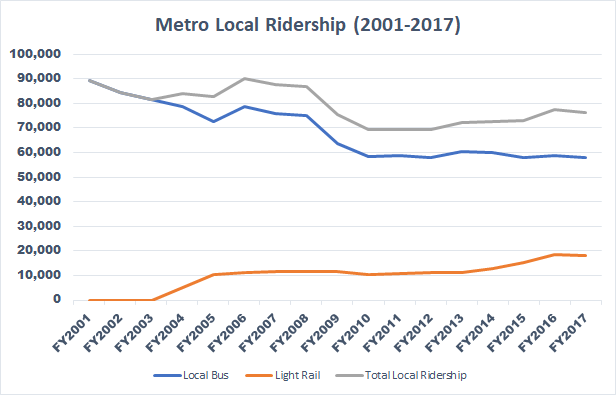
In 2001, the last year before Metro began spending money on light rail, Houstonians took over 89 million trips on Metro’s local bus service.[i] Last year, the combined trips on the local bus service and the light rail system came in at about 76 million, a decline of over 14% since 2001. [ii] Over that period Harris County’s population has grown by over 30%.
Considering that after Metro invested $2.2 billion in light rail, yet fewer Houstonians are opting to take transit, it seems a good time to ask: Was it worth it?
This, of course, is not what the promoters of Metro’s light rail system promised back in 2003. Nor, I expect, is it what the voters thought they were going to get when they voted in favor of the 2003 referendum which authorized the construction of the light rail system. The rosy projections of increased transit ridership originally promised in 2003 have long since been abandoned. Instead, the program appears to have mostly converted a significant portion of bus riders to light rail riders.[iii]
This means the light rail has done virtually nothing to reduce congestion. Getting some buses off the street probably improves congestion to some minimal degree, but then I have never been in a traffic jam on Harrisburg anyway. And the light rail causes its own congestion, like the fact that we can no longer synchronize the lights downtown.
Although Metro’s leadership appears to have mostly abandoned the idea of building more light rail, it still seeks to justify the investment on a variety of other grounds.
It argues, for example, that the light rail has spurred development in the areas it serves. And there is some evidence that supports that contention. The East End is certainly experiencing a revival that more or less coincides with the light rail being extended into that neighborhood. To what degree that new development was caused by the light rail or independent of it is difficult to ascertain.
In my opinion, Metro undermines its credibility by frequently citing the total new development along the light rail lines. I think the last number I heard was $8 billion. But that includes all the new development in the Texas Medical Center, which had absolutely nothing to do with the light rail.
But whether there have been any collateral advantages from the construction of the light rail system is not the question we should be asking ourselves. The question should be: Why did Houstonians support building in the first place?
I don’t have any polling from the time of the referendum, but polling on transit over a long period of time has shown that most people support transit because they hope someone else will take it and relieve the congestion they experience. (SeeIf So Many People Support Mass Transit, Why Do So Few Ride?, Eric Jaffe, City Lab, September 22, 2014.) Contrary to the public’s impression, very little definitive scholarly research shows that transit reduces congestion.
This raises what I have always thought that is one of Metro’s principal problems: the lack of clear objectives. Metro’s vision and mission statements are so vague that they can be interpreted to mean anything. Interesting, neither even mentions the word “congestion”. (Click [here]to read vision and mission statements.)
It is impossible to manage an organization that does not have a clear objective(s). This is a conversation we need to have. What do we want Metro to do? Is it to reduce congestion? Provide transportation to those who cannot afford a car or are physically incapable of operating one? Spur redevelopment? Perhaps Metro should have another referendum to answer this fundamental question.
And then the question we will have to ask ourselves: What is the most cost-effective strategy to accomplish the objective(s)? There is no way to know that answer, until we know the objective. But I doubt light rail, especially at-grade light rail, is going to be the solution for any objective.
In the meantime think about this. What could we have done instead with the $2.2 billion that was spent on light rail? The answer is lots. Like solving most of our flooding problem or resurfacing virtually every street in the street in the City or repairing our dilapidated wastewater system or putting more police officers on the streets or demolishing some of the thousands of dangerous buildings in the City or any one of dozens of other critical priorities facing the City.
The question is not whether light rail is a good thing or not. The question is whether it was the best use of $2.2 billion of taxpayer money. The answer to that question is pretty clearly, “No.”
[i] Metro keeps separate ridership statistics on its local service, which covers the city street grid, and its “Park & Ride” service, which shuttles passengers from the suburbs using its HOV system.
[ii] The FTA counts “unlinked” trips. That is anytime a transit rider get on a transit vehicle. Because riders frequently must transfer between buses and/or trains, a single commute can result in a transit agency (including Metro) counting a single commute two or more times. Some Metro critics argue that Metro’s ridership statistics are inflated because the light rail system resulted in more transfers as riders were forced to take a bus to an LRT terminus to continue their trip. I have not found any data that would support or refute this claim. Metro can track transfers on riders which use the Metrocard, but it has only aggregated that data for one short term study fairly recently. I cannot think of any way to reconstruct the data going back to 2003.
[iii] At least, that is what pretty clearly happened when the original red line on Main Street was opened 2004-2005. It also appears to have occurred when the Main Street line was extended to the north in 2013. However, there was an increase in ridership when the East End and University lines were opened in 2015, without any corresponding decrease in bus ridership. This was about the same time that Metro rolled out its Reimagine program, which dramatically restructured its bus routes. So, it is difficult to sort out whether the new light rail lines had fundamentally different ridership dynamics or if there was a loss in ridership along those lines like the Main Street line that was offset by an increase in ridership from Reimagine.
There is only one county wide race on the Republican primary ballot in Harris County. That is for the 295th Civil District Court between primary front-runner Richard Risinger and Michelle Fraga. I doubt the majority of Republican voters are going to be rushing to the polls for either one, even though it is an important position. Such is the state of electing judges in a partisan manner.
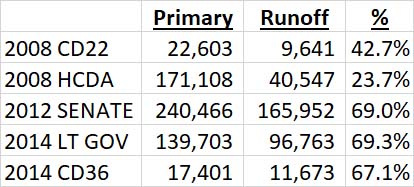
So what’s going to drive turnout? Glad you asked. That would be the turnout in the runoff in CD2 between primary front-runner Kevin Roberts and Dan Crenshaw. On primary day, March 6th, a total of 47,428 ballots were cast in CD2, with 46,245 choosing to vote in this race. Given its high profile, a fair number of those voters will return to vote in the runoff. But it probably won’t be as high as your gut tells you. Let’s take a look at a few historical instances in Harris County.
Given the high profile and amount of money being thrown around in the CD2 runoff, let’s say that the turnout will be 70%, close enough to the last three high profile races. The problem is that drop off in the 2008 Harris County DA’s race, a very high profile race that was county wide. If only 23.7% of voters returned for that race, the drop off for a single judicial race is going to be huge.
Of course, there is one more race on to consider, that being the JP 5, Place 2 runoff between incumbent Jeff Williams and Mike Wolfe. There is a good bit of overlap between CD2 and JP5, so I don’t think that it is going to affect turnout one way or the other.
As you know, all three of the major slates in Harris County Republican Party politics “endorsed” Kevin Roberts. They split on the judicial race, with Hotze and Polland choosing Risinger, Lowry choosing Fraga. And then they were unanimous again in “endorsing” Wolfe.
Looked at in this way, you begin to see the mountain that Dan Crenshaw and Jeff Williams have to climb. Richard Risinger is a little better off because of Hotze’s mail ballot expertise with older voters but he is going to have to overcome the money behind Roberts, which is spewing dishonest trash against Crenshaw and Williams. Of course, Risinger was in a runoff in 2008 and Lowry attacked his family – Risinger lost. Lowry is not an honorable man.
Take a look at Terry Lowry’s Link Letter. Little fella has never been particularly honest but this year, he stoops to a whole new level of disgusting.
I don’t know how many of Lowry’s acolytes are going to believe this trash and vote because of it but there will be some. Crenshaw is a newbie to politics and the consultants he is now using are new to Harris County politics, so the chances of offsetting this trash are not high. And if Lowry’s “good Christian” voters follow his lead, this trash might rule the day.
How then can Crenshaw, Williams and Risinger overcome this type of blatant dishonesty? With your help and only with your help. There is a guy I know that has a little line that he uses before meetings and it goes something like this: “When you say someone needs to do something, remember this: you are someone! So do something!”
That guy’s name is Tom Zakes, a long time Harris County Republican activist and Downtown Houston Pachyderm Club board member. Tom sent this out using the DHPC maillist:
It pains me to write this, because a good number of the people involved have been friends of mine for decades.
I have never been one to refer to the mail out slates in Harris County as “pay-to-play.” It could be that a candidate who buys advertising then gets an endorsement that he wouldn’t have had otherwise. But I have never seen that definitively in the Texas Conservative Review (Gary Polland & Marc Cowart), Link Letter (Terry Lowry) or Conservative Republicans of Harris County (Steve Hotze & Jared Woodfill). I have been approached by other groups that put out slates, asking me if I could “help them get the word out” about their endorsements if they backed me when I was running for city council in 1989 and for JP in 2016.
I grew up with bare knuckle politics, and I have never shied away from a political fight. I learned at an early age to read between the lines in political advertising. And I have seen how candidates and their operatives will often stretch the truth.
Though I expect negative campaigning, what I refuse to participate in is false advertising. And the runoff edition of the Link Letter has crossed that line. In addition to attacking former Navy Seal Dan Crenshaw, Lowry also draws a bead on Justice of the Peace Jeff Williams.
The basis of his ire is that Williams performs same sex marriages. But that is misplaced. After the 2015 Supreme Court ruling in Obergefell, same sex weddings came to Texas, whether we liked it or not. After that, the Democrat County Attorney, Vince Ryan, issued an opinion letter to all the judges in Harris County: If you are going to perform any weddings, you MUST perform same sex weddings. Refusal to do so could result in action being brought to remove them from office. And we’ve seen how willing Vince Ryan is to waste county resources to remove public officials like Dave Wilson who he doesn’t like.
Williams and his counterpart judge in Precinct 5, Hon. Russ Ridgway, both stopped performing weddings in response to that directive. However, their constituents kept coming, wanting a simple wedding in front of a JP instead of a big expensive wedding at a church or rented hall. Ridgway and Williams had to decide: do we inconvenience more than 90% of our constituents because of a ruling we disagree with, or do we follow the directive from the County Attorney? They decided to go back to performing weddings. And remember, weddings performed by a Justice of the Peace are a civil ceremony, not a religious one. And as a side note, all 16 of the JPs in Harris County, including the 6 Republicans, perform weddings. Will Lowry go after the others, next?
Even more disturbing than what Lowry wrote is the “Guest Editorial” by my friend Eric Dick. Even the headline is a lie. It says “I’m voting for Mike Wolfe and You Should Too.” The problem with that sentence is that Eric and his wife (and two lovely daughters) live in Precinct 1, where they are registered to vote. So unless he commits vote fraud, Eric is NOT voting for Wolfe for JP.
He follows up with descriptions about how Williams allegedly acts in his court. The problem is, in the decade that Eric has been an attorney, he has appeared as attorney of record in a grand total of three cases in that court. And all three of those were filed when Bill Yeoman was the judge. Dick complains about an unnamed woman who was forced to stay in Court from 7 am to 7 pm three days in a row. But Williams’ Court has its earliest docket at 8 am, and the staff opens the doors at 7:30.
Wolfe has been invited to speak at our Downtown Houston Pachyderm Club about his race for JP. Both times, he accepted, and was scheduled to speak. Both times, he cancelled, the second time when he was the only scheduled speaker, leaving us to scramble to find a replacement in order to have a program.
I would have no problem with Eric Dick saying “I am on the Board of HCDE with Michael Wolfe, and encourage you to vote for him.” I would have no problem with Terry Lowry saying “I know Kevin Roberts from church, and think he’s a great guy. Please vote for him.” But to violate the Ninth Commandment by bearing false witness against one’s neighbor (Exodus 20:16), or committing an abomination by lying (Proverbs 12:22) are serious reasons not to vote for a candidate.
The runoff edition of the Link Letter is a lie. There can be no question about that and I’m glad that Tom has finally recognized that and said something about it. After all, he is someone. And so are you. See something, say something. Find a friend who lives in CD2 and make sure they know about the lies. You too are someone.
One of the more interesting things about this version of the Link Letter is that there are no “paid political advertising” disclaimers to be found. That is indeed interesting. Why do you think that is? My guess is that Lowry is trying to hide the amount of money that Kevin Roberts’ brother in law Mark Lanier is pouring into this race. After all, Lanier has been financing Lowry for years, allowing Lowry to spew his particular brand of hate. Why stop now? But that is only a guess. We already know that Fraga and Wolfe paid Lowry $15,000 for the primary. Will their new campaign finance reports list this trash as an in-kind contribution?
Kevin Roberts could have stopped this. But winning is apparently far more important to him than living a life for Christ. Hey, it happens. None of us are immune to the power of Satan.
But you can stop this. Vote for Crenshaw, Williams and Risinger. Tell your friends to vote for Crenshaw, Williams and Risinger. After all, you are someone.
Been a bit since I’ve agreed 100% with Tio Pablo but his thoughts on the recently ordered bond election in Harris County is spot on. From the Inbox:
Are the “Dog Days of Summer” Setting in on Harris County Taxpayers? Series of summer special property tax rate election events coming, but still time to move them to November!
HOUSTON – Senator Bettencourt (R-Houston) is speaking out on behalf of taxpayers following the announcement by more than one taxing jurisdictions that special elections to raise property tax rates will be occurring throughout the Summer and better public policy is to hold them on the November General Election date. This is occurring so quickly that the Klein ISD Trustees are voting on a TRE election Monday, May 14.
I am worried about voter fatigue as well taxpayer’s pocketbooks!” said Senator Bettencourt. “Rather than spend money on special elections these taxing jurisdictions still have the chance to do the right thing and schedule their proposed tax rate increase elections in November.”
Governor Greg Abbott (R-Texas) granted permission for Harris County to hold an estimated $2.5 billion Harris County Flood Control Proposition on a non-uniform election date on August 25th, the date of Hurricane Harvey’s landfall. In his approval letter, Governor Abbott highlighted, “…billions of federal dollars either are currently available to Harris County or will be available to the county before it has the ability to issue the bonds requested…”
In their letter to Governor Abbott, Harris County Commissioners Court stated, “We must show the various federal agencies that matching funds are available now in order to apply for Harvey related grants that are already available.”
However, the Governor also stated in his letter, “Congress purposefully provided much of those matching dollars through Community Development Block Grant (CDBG) funds so that local government would not need to match the federal grants.” This strongly suggests that waiting to hold the election in November will not stifle the flow of federal money nor change the facts that the CDBG funds do not need a local match.
At their quarterly Executive Committee meeting this week, the Harris County Republican Party nearly unanimously passed a resolution calling for “Harris County, City of Houston, and Klein ISD governments to schedule their respective bond and/or tax cap repeal elections as part of and on the November General Election date.” Resolution author Clint Moore stated, “Rather than disenfranchise hundreds of thousands of voters, our elected officials should put these tax rate increase elections on the November ballot. I thought we were beyond choosing these sorts of obscure election dates, but I guess not.”
Voters throughout Harris County may return to the upcoming May 22 Primary runoff election, a probable 9 penny June tax rate ratification election in Klein ISD the weekend of the Republican State Convention, a county bond election in August, and potentially the Mayor’s announcement that he wishes to bust the voter approved property tax rate cap by November general election. “It is a fundamental truth that our Republic functions better when more people are able to cast their ballots in a Democracy,” concluded Senator Bettencourt.
###
I watched the Commissioner’s Court meeting when they made the decision to hold the election in August. You can watch it by clicking here and then clicking on Item V, (Part 1 of 2). It was a nightmare for anyone that cares a whit about fiscal policy, small government, transparency, open government or basic fairness to taxpayers. Strong statement since I am a huge fan of Judge Emmett and Commissioners Radack and Morman but that is exactly the way I saw it.
The decision basically boiled down to the best guess of the commissioners as to which date it was most likely to be approved by the voters. Commissioner Rodney Ellis was the only one that wanted it in November but it wasn’t for any of the reasons Bettencourt mentions above, he simply thinks that more of the po’ folks will turn out to approve it. He changed his vote at the urging of Commissioner Radack so that the court would be unanimous when it sent the letter requesting permission to hold the election to Gov. Abbott.
Because there has been NO groundwork laid, there was only an open ended conversation about which group of identity politics driven activists would get their fair share. It was disgusting. Speaker after speaker lined up extolling the virtues of their particular identity group wanting a share of the bond money, the bigger, the better. It was like watching a litter of kittens lining up in front of mama cat. This is what happens when government is driven by identity politics and activism instead of sound fiscal and engineering policy.
Maybe I’m being too hard on the Commissioners but I don’t think so. Disgusting.
Third, considering that an August election would result in a very low voter turnout, there is an issue of legitimacy. If this election results in a turnout of 50,000 voters voting in favor of the bond, while a mere 30,000 vote against, that means only a tiny percentage (like 2-3 percent) of the 2+ million voting electorate of Harris County ends up making the decision that everyone else has to live with. I’ve long gotten tired of this kind of stuff happening, which is why I’ve been pushing for several years now to require voter quorums for bond elections to pass.
Believe it or not, I might actually vote in favor of a bond proposal for flooding, but only after my concerns listed above are addressed. I would like to see a full vetting of the bond proposal, which means delaying the public vote until the November 2018 election. That would give the electorate another 2 1/2 months to analyze and debate the proposal. The November 2018 election will also result in a higher turnout, which will give the bond vote stronger legitimacy.
There is no need to hurry, so why not wait?
Neal is exactly right. Why not have a full vetting before voting on such a nebulous proposition? Note that he doesn’t sound like an angry voter, just a frustrated one that knows full well there will not be a full vetting and most of the bond is simply going to be guess work on the high side of the equation.
There is no need to have the bond election in August. The only reason to do so is a political calculation on the part of the Republicans on the court. Sad.
The Harris County District Attorney has filed a sealed court motion to recuse her office from further investigation into a Dolcefino Consulting criminal complaint filed against Mayor Turner for hiding e-mails.
Judge David Mendoza, the ethics counsel for Kim Ogg informed us of the decision Thursday.
The reason: Dolcefino Consulting served as Communications Advisors to Ogg in her campaign for District Attorney.
“One of the reasons I wanted to help Ms. Ogg become District Attorney was because of her promise to me to be aggressive on issues of public integrity. If I had known then she would seek to recuse herself from investigations involving my firm I would have told her no,” says Wayne Dolcefino, President of Dolcefino Consulting. “I find it odd that when my office complained on a powerful Democratic politician our Democratic DA got a sudden case of conflict of interest.”
Dolcefino Consulting accused Turner of hiding e-mails with Maya Ford, a virtual goddaughter to Turner, and the beneficiary of consulting contracts since Turner took office. Ogg’s office has been sitting on the complaint for 5 months, and there is no evidence they’ve even asked City Hall to show them the e-mails.
“In my view, the District Attorney is already in violation of the law too, since it required them to respond within a month to our complaint,” says Dolcefino. “Houstonians should be asking some tough questions about public integrity in this town.”
Judge Mendoza says the Turner case also became intertwined with the prosecution of Cypress Creek EMS for violating state charity laws. The Northwest Harris County Ambulance company faces criminal charges stemming from a complaint from Dolcefino Consulting after refusing to turn over payroll records for 911 employees. Ogg has now asked for a special prosecutor to take over that case, even though it has been ongoing since she became District Attorney fifteen months ago.
The FBI is probing possible fraud in the 911 service in ESD #11 and employees of CCEMS recently testified in front of a grand jury.
“It is no secret my office has been highly critical of Ms. Ogg’s alleged office of Public Integrity,” says Dolcefino. “Kim Ogg has now been District Attorney for fifteen months.”
Records obtained by Dolcefino Consulting show Ogg’s office waited five months to tell the Houston Independent School District after we formally complained some Democratic school board members were hiding phone records. By the time HISD turned over the records, the phone records we wanted had been discarded. The DA let them get away with it.
Early this year Ogg’s office falsely claimed our complaint about Democratic HCC Board Member Adriana Tamez was unfounded. Dolcefino Consulting turned over hours of video surveillance and utility records proving Tamez did not live in the District she was elected to represent. The Public Integrity Unit claimed they did a thorough investigation, but refused to turn over records showing the public what they did or didn’t do.
“Our District Attorney has the authority to initiate investigations without a formal complaint, but those are their rules. Now, when my Investigative Communications Firm complains, they play games, and now want to hand off the hot potatoes,” says Dolcefino. “In this town, a growing number of people are hiring us to help get them justice. Ms. Ogg could have chosen to help us clean up the town, but she isn’t.”
It’s been clear since Dan Crenshaw made the runoff in CD2 that the momentum was on his side. Obviously, Kevin Roberts and his sidekicks recognize this, so they bring out the big word – liberal. But…well, take a look for yourself. First the friendly Dr. Hotze and Mr. Woodfill let us know that Crenshaw is a big ol’ librul:
Those two righteous men are as bold as lions, don’t you know?
Now, let’s review those “liberal” positions of Dan Crenshaw: (or you can go to dansbiggovernmentplan.com)
We live in interesting times. Republicans USED to be in favor of controlling the costs of entitlement programs. Apparently that isn’t in vogue these days, instead we need to expand entitlements so that politicians can be elected.
So let’s take a look at what Crenshaw’s plans are.
Medicare – allow Medicare to negotiate drug prices like the VA does.
Sounds good to me. But for Kevin Roberts, Dr. Hotze and Mr. Woodfill, it is liberal to try and be fiscally conservative. Why, Medicare recipients have the RIGHT to demand name brand drugs regardless of the cost!
Transition Social Security to a pay-as-you-go and investment plan with private accounts.
Does that sound liberal to you? It is a fact that the Social Security system is getting top heavy with retirees vs active workers. Dan Crenshaw says, you know what? That’s a problem. Here is how we fix it. Liberal?
Dan Crenshaw wants to avoid unexpected cuts to Social Security benefits in the future.
Back to the Republicans used to believe line, Republicans used to believe in being honest and addressing problems head on, which Dan Crenshaw does. But the righteous lions think that we should continue to lie to retirees instead of addressing the problems. Liberal?
You want to know where Kevin Roberts stands on Medicare and Social Security? Well, you’re going to have to ask him because his campaign website doesn’t have a single reference to Social Security or Medicare. How about that? Old school Republicans might think a guy running for Congress should mention those very important issues.
You know what Kevin Roberts’ campaign website does have? Here are a few snippets:
Get rid of the “Deep State” in Washington by ending unneeded agencies and removing thousands of bureaucrats. (oooh, skeery!)
Strengthen our border security with walls, thousands of more border agents, and equipment to detect and apprehend those crossing illegally. (can we say buzzwords?)
Relentlessly demand action, funding, and support from federal and state agencies. (snort, like our other Republicans?)
Demand sanctions on Russia, China, Iran, North Korea and any businesses that help them foster terrorism and hostile actions against free people. (wow, that has worked so well for us!)
Stop liberal attempts to infringe on law-abiding gun ownership. (back to them buzzwords again)
End federal taxpayer funding of Planned Parenthood and other abortion providers. (buzz, buzz, buzz)
Is this guy serious? I thought that he was but clearly he has taken a page from every establishment Republican playbook. Good grief.
Meanwhile, Dan Crenshaw is taking policy seriously and giving voters a clear look at what lies ahead.
Don’t miss the April general meeting! Monday, April 2, 2018. Guest speaker: MWRW member, Mary Sergesketter, and the topic is “The Influencers, the Candidates and the Voters….a discussion about the slates in Harris County.” This is a program you will not see anywhere else!
10:30 A.M. Social, 11:00 A.M. Program, 12:00 P.M. Lunch (optional). Please make your reservation for lunch by Thursday, March 29th via email.
This should be a very interesting meeting and might even get me out of hibernation to be there. Mary has been around the HCRP for a long time and will be able to discuss the various slates intimately. I’ll be interested to hear her thoughts on using the slate mechanism to get better candidates on the whole, instead of having a November candidate slate full of holes because of niche issues.
And speaking of slates, there is a small one called Katy Christian Magazine whose publisher doesn’t understand the law regarding political advertising. As you know, political advertising is highly regulated by the State of Texas. Here are the specific laws taken directly from a Texas Ethics Commission ruling against another local slate in 2011:
“Political advertising” is defined, in relevant part, as a communication supporting or opposing a candidate for nomination or election to a public office that in return for consideration, is published in a newspaper, magazine, or other periodical. ELEC. CODE § 251.001(16).
The rate charged for political advertising that is printed or published may not exceed the lowest charge made for comparable use of the space for any other purposes. ELEC. CODE 255.002(b).
In determining amounts charged for comparable use, the amount and kind of space or time used, number of times used, frequency of use, type of advertising copy submitted, and any other relevant factors shall be considered. ELEC. CODE 255.002(c).
The documents at issue supported the election of candidates to public office. Therefore, they are political advertising. The evidence indicated that two candidates for public office purchased the same amount of advertisement space from the respondent. However, the candidates were charged rates differing by $5,000 for the same amount of space. Therefore, there is credible evidence of a violation of section 255.002(b) of the Election Code.
In the Katy Christian Magazine case, Judge Jay Karahan paid $1,200 for a one-half page ad in the February / March 2018 issue of the magazine. The same issue also contained a one-half page ad for Judge Karahan’s opponent Dan Simons. After reviewing Mr. Simons’ campaign finance reports, Judge Karahan saw that Mr. Simons only paid $400 for his comparable use ad.
Judge Karahan inquired about this discrepancy via email to Joseph Menslage, President/Publisher of Katy Christian Magazine. Mr. Menslage responded thusly:
The reason why Mr. Simons got a better deal is because he negotiated with us on the pricing. As a business owner, we do have the right to negotiate.
Of course businesses have the right to negotiate. But the law says that Mr. Menslage must charge candidates the lowest charge made for comparable use of the space.
I have nothing against this particular slate (other than the “Christian” branding) but I hope that Judge Karahan files a complaint with the Texas Ethics Commission so that Mr. Menslage will have a better understanding of the law and his responsibilities when accepting payment for advertising. There are other examples of this practice in the same and previous issues of the slate.
Perhaps Mary Sergesketter will address this problem in her talk about the slates.