This is going to be a fun week at the Downtown Houston Pachyderm Club! None other than master investigator, communicator, and all around fun guy Wayne Dolcefino will be the speaker at the weekly lunch meeting! Here’s a short bio:
Wayne Dolcefino
Wayne Dolcefino is one of the nation’s most decorated journalists. Thirty Emmy Awards from the National Academy of Television Arts and Sciences, Five Charles Green Awards, an Edward R. Murrow award, a Jack Howard Award for investigative reporting, numerous honors from the Associated Press and Texas Association of Broadcasters, and an unprecedented three medals from the international journalism organization Investigative Reporters and Editors.
For nearly 27 years Dolcefino headed up the 13 Undercover Unit at KTRK TV. This investigative unit specialized in exposing public corruption, wasted taxpayer money, government malfeasance and fraud. As head of the unit, Dolcefino managed the investigative process, and was involved in the marketing and advertising of KTRK TV’s investigative news product.
Between 1985 and 1979 Dolcefino was an investigative reporter and radio talk show host at KTRH Radio. Prior to that he worked at KLBJ Radio in Austin , Texas.
In December 2012 Dolcefino created Dolcefino Consulting. This firm consults on crisis management, ethics reviews , informational marketing and media relations and provides production , investigative services and expert testimony in litigation. Dolcefino has significant experience in courtroom litigation relating to first amendment issues.
In early 2013 the Association for Certified Fraud Examiners gave Dolcefino the Fraud Impact of the Year Award for his painstaking investigation of a lawman’s charity.
What that bio doesn’t tell you is how good of a storyteller Dolcefino is. It is going to be a fun, fun meeting!
In case you’ve forgotten, the club meets every Thursday from noon until 1 pm at the Spaghetti Warehouse in downtown Houston. Get there a little early to network and meet people. A flat $8 buys a great lunch including drink and bread. Oh, my, that bread!
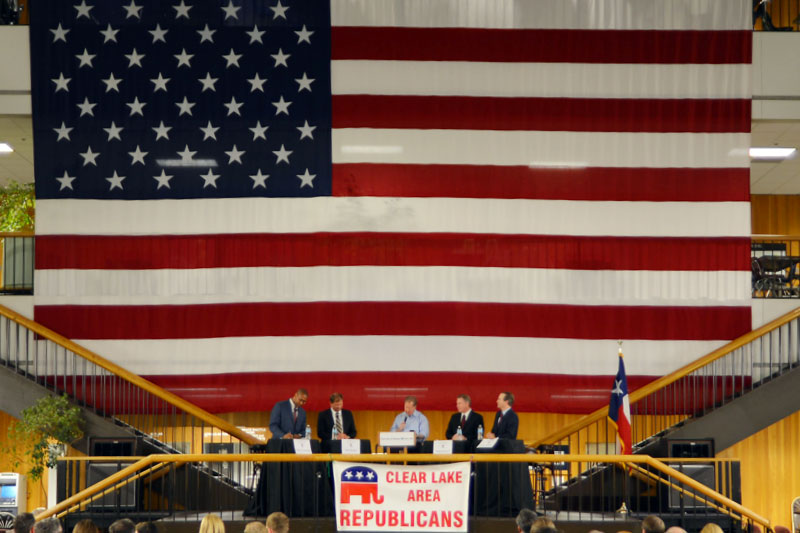
The format of the debate was fairly unique and split into three segments. In the first segment, a candidate was first asked a question by the moderator and had two minutes to answer. After the candidate’s answer to the moderator’s question, each of the other three candidates were given a chance to ask the candidate a follow up question related to the moderator’s question, for which the first candidate was given one minute to answer. And at the end, each candidate was given two minutes for a closing statement. This format resulted in an engaging and challenging debate with far more interaction between the candidates than in other political debates I’ve seen around Harris County.
The second segment was a “lightning” round, with each candidate asked a question by the moderator and given one minute to answer. The third segment featured each candidate answering one question submitted by the audience and given 30 seconds to answer.
I enjoyed the first segment, although at least one of the questions had nothing to do with running the RPT. My suggestions for the next debate CLAR holds would be to stick with the first segment, make certain that the questions were germane to the position in question, and drop the “lightning” round and audience questions segment.
Robin Armstrong
The two questions Armstrong addressed in the first segment were about ballot integrity and the amount of time he could commit to the job. His “lightning” round question asked if he had been sued before. His audience question asked if he thought that every county in Texas should have a Republican primary.
I can’t say that I was overly impressed with his answers. They seemed to me to be almost boilerplate. He struggled with the question about the time commitment necessary to do the job. At one point he said that Munisteri spends 60-70 hours a week because he likes to drive places and that he would instead use Southwest Airlines for his travel. He also stated that he has told staff at the RPT that he would be in Austin at least two days a week. The other candidates obviously asked how he could do that and still maintain his medical practice and if he would visit other parts of the state. He maintained that he is a good manager of his time and that he was the boss of his practice so he could set his own schedule.
The real problem for Armstrong in this debate was his answer about being sued. I thought at first that the question was probably intended for Woodfill given his legal problems but it turns out that it was on target for Armstrong. Being that he is a doctor, I wasn’t surprised when he said that yes, he had been sued once many years ago and that the suit had been settled. He then talked about his work in the late 90’s and early 2000’s in support of tort reform and that we needed to go further with it. It sounded like a good answer until someone told me that I should verify it because it wasn’t true and this was the second time he had answered the same way.
Turns out that Armstrong is in the middle of another medical malpractice lawsuit today. It is incredible to me that Armstrong would not answer this question with the whole truth, knowing how easy it is to check his veracity. All you have to do is search the Galveston County District Clerk’s website and, shazaam, there it is. Below is a screenshot, click here to go directly to the website.
Galveston County District Clerk screenshot with two lawsuits
Notice that one was from 2005 and one from 2014. Who in the heck advised him not to come clean? I have no idea about the merits of the lawsuit but it is in fact a second lawsuit against him for medical malpractice. In fact, an expert witness against him filed his report the day before the debate. His current defense against the lawsuit is that it was filed about 30 days after the statute of limitations expired and he is asking the judge to dismiss it.
Tom Mechler
Mechler’s first segment questions were about his campaign experience and his view on immigration. His “lightning” round question was to define conservative and his audience question was how to increase evangelical turnout and straight ticket voting.
During the follow up questions from the other candidates, Wade Emmert pointed out that Mechler’s experience running a county party was a decade ago in a very small county in the Panhandle. Mechler handled it well with an analogy to football, citing the need to master the basics of blocking and tackling to be successful. He then talked about expanding on the basics by using technology to target specific voters, ala the Abbott campaign, to increase voter turnout.
I don’t think that his personal views on immigration are relevant to leading the RPT. The question was posed to him because several members of CLAR and the Clear Lake Tea Party think that he did something untoward as chair of the platform committee in regards to the so-called “Texas Solution”. He took the opportunity to explain that as chair, his job was to bring the various factions together to come up with a plank and not to force his personal beliefs on them.
About that evangelical question, the point was raised several times during the debate that “4 million evangelicals stayed home” in 2012 because Romney was too moderate, thus causing his defeat. That false meme has been circulating since the day after Romney lost. I wish that people would check the facts instead of blindly repeating false information. The FACT is that Romney received MORE votes than John McCain did in 2008. Please, check it out for yourself and then STOP repeating this nonsense so that the correct strategies to win elections can see the light of day.
Mechler’s definition of what conservative means was interesting to say the least. He says that to be considered a conservative you must be pro-life, pro-traditional marriage, pro-2nd amendment, and against political correctness. I guess fiscal issues, a pro-growth regulatory environment, and freedom/liberty no longer matter? Like I said, interesting.
Wade Emmert
Emmert’s first first segment question was how would he deal with elected officials that did not follow the party platform and did he disagree with any of the planks in the platform. His second first segment question was about expanding the Republican voter base and increasing Republican voters in low income areas. His “lightning” round question asked if he thought Republican auxiliaries were important. His audience question asked if he had any experience combating Democrats.
Armstrong asked a follow up question using last summer’s controversy at the state convention involving the Log Cabin Republicans being refused a booth at the convention. Armstrong referred to that incident several times during the evening. Emmert had a great answer, saying that Republicans cannot be afraid of debate and that although he disagreed with the LCR’s position on gay marriage, he was secure enough in his beliefs to allow the debate. He also asked how the party can grow if we shut out everyone that disagrees with a plank in the party platform.
Mechler challenged him on the one race that Republicans did win in Dallas County, the District Attorney’s race, asking him if the best way to win was to get Democrats to switch parties. Again, Emmert handled it very well, talking about the history of the DA candidate that won, the conditions in Dallas County prior to his chairmanship, and that, yes, he would take Democrats that chose to switch parties. Armstrong asked him why there were so few Republican challengers to the Democrats in judicial races. Emmert talked about the difficulty he had in convincing people that it wasn’t a waste of time and money after so many years of neglect under other chairs in Dallas County, noting that success breeds success and now that they had won the DA race, he expected it to be easier to recruit candidates in the future.
After listening to Emmert’s description of the improvement for Republicans in Dallas County under his leadership, I decided to check the facts. Unfortunately, the facts do not support Emmert’s enthusiastic narrative of a changing landscape for Republicans in Dallas County. Here are a couple of quick tables showing straight ticket Republican voting before and after he assumed the chairmanship in May, 2011.
Presidential Election
{997ab4c1e65fa660c64e6dfea23d436a73c89d6254ad3ae72f887cf583448986} Straight R
2000
49.28
2004
48.32
2008
39.16
2012
40.16
Gubernatorial Election
{997ab4c1e65fa660c64e6dfea23d436a73c89d6254ad3ae72f887cf583448986} Straight R
2002
49.06
2006
46.14
2010
46.15
2014
44.65
Emmert was responsible for the results in 2012 and 2014. As you can see, in 2012 it was a small increase of 1{997ab4c1e65fa660c64e6dfea23d436a73c89d6254ad3ae72f887cf583448986} but in 2014, it was a drop of 1.5{997ab4c1e65fa660c64e6dfea23d436a73c89d6254ad3ae72f887cf583448986}. I’m not saying that Emmert didn’t improve things, he might have but the numbers fall a bit short of the enthusiastic narrative he gave at the debate.
Jared Woodfill
Woodfill’s first segment questions were about the finances of the Harris County Republican Party under his leadership and what his plans were to unify the various factions of the party should he be elected RPT Chair. His “lightning” round question was about involvement in local, non-partisan elections. His audience question asked to list his top three priorities for the party.
Mechler and Emmert were tough on him during the follow up questions on finances. If you have heard Jared, or read David Barton’s fawning endorsement of him, you’ll hear the claim that Jared raised over $20 million in his tenure as HCRP Chair. Mechler busted him, pointing out that 80-90{997ab4c1e65fa660c64e6dfea23d436a73c89d6254ad3ae72f887cf583448986} of that money was actually a pass through from judges. Woodfill danced around it but Mechler is factually correct. Emmert asked him about the overall condition of the HCRP’s finances and again, Woodfill danced but anyone that has paid attention to the party knows that the finances were a disaster under his leadership. I like Jared and think he has many, many political skills but financial management simply isn’t one of them. And he has a tendency to try and revise history.
Woodfill’s tendency to view the RPT as an extension of the church was on full display during the debate. His top three priorities for the party were the border, abortion, and gay marriage. In answering Armstrong’s question about allowing the Log Cabin Republicans a booth, he flat out said no. Not only no to the LCR, but no to ANY group that disagrees with ANY plank in the party’s platform. When asked how the party could grow under those conditions, he used Dan Patrick as an example of someone that sticks to their principles and can still win. His method of growth, using the false narrative of evangelicals not turning out during 2012, was to meet with pastors, get them to support Republicans from the pulpit, then the people in the pews would go to the polls. Pulpit to pews to polls is how he phrased it.
In a follow up to the unity question, Mechler asked him if he would continue to sue municipalities about local issues and if so, wouldn’t that open up the party to paying attorney fees and court costs when he lost? Woodfill was clear that yes, he would use the RPT to sue if municipalities enacted laws contrary to the RPT platform. He stated that the leader of the RPT must embrace the platform, not run from it.
Straw Poll Results
Here are the results of the straw poll taken after the debate (click to enlarge):
Who should the SREC elect?
That is the question because the grassroots of the party (precinct chairs) do not get to vote for Munisteri’s interim replacement. We’ll get to vote on the permanent replacement at next years’ state convention. So what should the SREC do now?
If I knew nothing about the background of the four candidates before walking into the building for the debate, I’d tell the SREC members that they should elect Wade Emmert hands down. His vision for expanding the party and his ability to articulate and communicate Republican values stood out during the debate. But of course, there is more to the story than a single debate.
I would rule Armstrong and Woodfill out immediately. When Armstrong was Vice-Chair with Chair Tina Benkiser, the party finances were in shambles, at one point being almost a million dollars in debt. Payroll was hard to meet some months, with staff having to go out and beg donors to contribute so that they would be paid. Woodfill’s financial management was almost as bad, although the HCRP didn’t go into debt. During his last term as chair, the professional staff was laid off and replaced with little more than interns in an effort to pay the bills. I remember the time that the office copier had to be returned because there was no money to pay the lease. It was an embarrassment for the largest Republican county in the state.
By all accounts Emmert has been a positive for Dallas County, although as noted above, it hasn’t shown up at the polls yet. He said during the debate that he has raised over a million dollars for the Dallas County Republican Party but in reviewing the party’s campaign finance reports, I don’t see anything close to that. I did like his to the point closing argument: “If you want someone to picket City Hall, I’m not your guy. If you want someone who can get Republicans elected, I’m your guy. “
And then we come to Mechler. He certainly wasn’t the most dynamic speaker of the bunch but he was able to get his point across most of the time. I thought his definition of “conservative” was goofy. But the one thing he has going for him is that he has been a part of Munisteri’s finance team from the start, has worked closely with the current staff, and has been an integral part of the RPT’s success in the last four years.
If I were an SREC member, I’d vote for Tom Mechler as Interim Chair. This will ensure that the party’s finances are stable through the 2016 primaries. Then, at the state convention, the grassroots will have the opportunity to choose the person that they want at the helm for the 2016 Presidential election.
Here’s to hoping that whomever the SREC chooses, the party will continue to have the electoral success and financial stability we’ve had under Chairman Munisteri.
Yea! A Saturday meeting. Instead of rushing halfway across Texas in the middle of traffic on a Monday night, the Harris County Republican Party Executive Committee will meet on a Saturday morning. This is a great change, even if it is for only one of the quarterly meetings.
Several items of note on the HCRP Executive Committee agenda. There are two items put forth by grassroots committees that Chairman Paul Simpson is against – apparently because they didn’t talk to him and get his permission to put them forth. You should have received an email from the Chair yesterday outlining his objections. Funny, I thought that the grassroots were supposed to have a bigger voice in his administration and wouldn’t need his prior approval. Oh well.
There are also three resolutions from precinct chairs. The first one seems to only have one sponsor, Clint Moore, and basically lays out State Rep. Debbie Riddle’s arguments against low income housing and the input that a state representative should have. I thought that a resolution needed at least ten precinct chairs to support it before being placed before the HCRP Executive Committee but I admit I don’t know the rules all that well.
The second resolution is against online voter registration. I’ll guarantee I’m in the minority on this one but I’ll be voting against it. If I can fill out a mortgage application online, buy a car online, and renew my Texas Concealed Handgun License online, why the heck can’t I register to vote online? This is yet another example, in my opinion, of a backwards Republican Party. We have to use the technology available to us to increase participation in the political arena.
The third and last resolution is a no-brainer, which is why I signed on as a co-sponsor. Thanks to John Baucum for pushing it. Here it is in full:
Honoring and Remembering the life of Bob Lee
WHEREAS, Robert Crayford Lee, 90, passed away peacefully on February 12, 2015 at the home he built in Houston, Texas surrounded by his family. He was born August 12, 1924 in Austin, Texas to Robert E. and Georgia Lee.
WHEREAS, Bob graduated from Waco High School, he then served in the United States Navy and graduated from the University of Texas in 1950.
WHEREAS, Robert devoted a long and full life to his family, his country, and God:
those things which he most loved. Bob was a lifelong Republican, activist, and co-founder of Republicans Against Marijuana Prohibition.
WHEREAS, He is survived by his loving wife of 64 years, activist and Precinct Chair, Ann Edwards Lee, of Ponchatoula, LA; He is also survived by sons, James Lee, Michael Lee, Robert Lee, Richard Lee, Donald and his wife Susan Lee; four granddaughters; 2 great-grandchildren; sister, Georgiabeth Mercier; and brother, James E. Lee.
BE IT RESOLVED THAT, the Harris County Republican Party honors and remembers the life of Bob Lee. We appreciate his commitment to activism and service to our great country.
BE IT FURTHER RESOLVED THAT, a copy of this resolution be awarded to Ann Lee in remembrance of Bob Lee.
Texas Monthly’s Burka Blog has been reinvigorated with the retirement of its namesake, Paul Burka, the terrific analysis of Erica Grieder, and the new hire, longtime reporter (and former Burka blogger) R.G. Ratcliffe. We’ll miss Burka for many reasons but I’m enjoying the new direction.
In his first post this time around, Ratcliffe puts to rest the meme that “44 states have open carry, why doesn’t Texas” by destroying the myths surrounding that meme. Here is a sample from his post “Not Such a Simple Picture“.
Probably the biggest misleading fact thrown out by the advocates of open carry is that Texas is some sort of laggard among the states in allowing handgun owners to openly carry their firearm. Governor Greg Abbott has said repeatedly that 43 states have some form of open carry laws and once declared, “If open carry is good enough for Massachusetts, it’s good enough for the state of Texas.” While Massachusetts might technically be called an open carry state, like many states there are numerous restrictions that make gun ownership far more restrictive than Texas advocates would admit, and Massachusetts just last year added additional restrictions to its laws.
Essentially, to openly carry a handgun in Massachusetts, a gun owner has to have a permit from a local police chief, and gun owners find it more difficult to get such permits the closer they come to major urban areas. The national advocacy group OpenCarry.org describes Massachusetts this way: “Massachusetts is not a traditional open carry state, but it is not a crime for Class A License holders to open carry. However, it is reported that some jurisdictions will use this as an excuse to revoke permits.”
I think that if you take the time to read the post, you’ll have a much better understanding of why Speaker Straus and other Republican leaders think it is going to be a tough sell in the House.
It isn’t in his post but in the comments Ratcliffe also puts to rest the idea that requiring a license for open carry instead of unrestricted open carry (what supporters call constitutional carry) is somehow an affront to the constitution. He quotes Supreme Court Justice Antonin Scalia in the Heller decision:
Heller v. the District of Columbia wiped out the idea that the Second Amendment only applies to the keeping of arms as part of a militia.
But Scalia also wrote that does not mean the government is unable to regulate firearms. To lift a quote from the opinion: “Like most rights, the Second Amendment right is not unlimited. It is not a right to keep and carry any weapon whatsoever in any manner whatsoever and for whatever purpose: For example, concealed weapons prohibitions have been upheld under the Amendment or state analogues. The Court’s opinion should not be taken to cast doubt on longstanding prohibitions on the possession of firearms by felons and the mentally ill, or laws forbidding the carrying of firearms in sensitive places such as schools and government buildings, or laws imposing conditions and qualifications on the commercial sale of arms. Miller’s holding that the sorts of weapons protected are those “in common use at the time” finds support in the historical tradition of prohibiting the carrying of dangerous and unusual weapons.”
So open carry with a permit or constitutional carry are policy issues for the Legislature to decide, but if the law is kept the way it currently is, that does not mean lawmakers are spitting on the Constitution.
I personally don’t care either way about open carry. I have a concealed permit and rarely carry a weapon and I doubt that I’d strap on a holster and walk around Houston with my 357 or Glock 17 on my hip if it were legal to do so. I wouldn’t want to end up like this dude. But if you want to, and you can convince enough lawmakers to make it legal, more power to you. I’m not certain that Rick Casey is right about relying on etiquette to keep people from carrying if it is legalized because I don’t see a lot of etiquette in today’s society. I do hope that if any open carry bill passes that it would require the same type of licensing that the current concealed carry requires.
In truth, I think all the noise around this issue is being ginned up to further divide the Texas Republican party. And that’s a shame because I think that the vast majority of November Republicans are either against open carry or, like me, just don’t care about the issue. But until those November Republicans decide to vote in the primary and take our party back, we’ll continue to be barraged with noise about inconsequential issues and be subjected to “wild men” making us the party of weird.
This should be a fascinating discussion. Hooper has extensive experience with TIRZ’s and their murky finances. Add in special guest Don Sumners, former Harris County Tax Assessor Collector, and you will learn more about this subject in an hour than most people have learned in years.
I know it is short notice but it is a good group to hang out with so if you don’t already have plans, why not head over there? Beautiful location too!
Harris County DA Devon Anderson was elected barely three months ago to fill out the remaining two years of the current term. On Sunday, she started the 2016 campaign with an op-ed in the Houston Chronicle titled “Let’s rethink how grand juries are selected“.
I support the efforts in the Texas Legislature to abolish the jury commissioner system. Whatever concerns the remaining district court judges have about using jury pools should have been assuaged long ago – other district courts have been using the jury pool system successfully for long enough that its viability cannot be questioned.
The same can no longer be said about the jury commissioner system. It is time to retire this historical anachronism and see where the jury pool system takes us. I am confident that it will result in decisions that are not only correct, but that will also have the confidence of the community as a whole.
Anderson, who called the current system “a historical anachronism,” joins a chorus of calls for reform in the midst of fierce national debate over the diversity of the people picked to be grand jurors, an issue that has been spotlighted by several high-profile cases across the country.
In November, riots broke out in Ferguson, Mo., after a grand jury decided not to indict a white police officer in the shooting of an unarmed black teenager. A month later, protesters took to the streets in New York City when a grand jury decided not enough evidence existed to go forward with charges against a white police officer whose chokehold, which was captured on video, led to the death of an unarmed black man.
A Houston Chronicle analysis in 2013 showed that Houston police officers shot 121 civilians – 25 percent of them unarmed – between 2008 and 2012 without a single officer being indicted.
This is a good start by Anderson to try and hold onto the job for Republicans next year. She’s also started cleaning up the house a bit, as noted by Murray Newman over at Life at the Harris County Criminal Justice Center and Mark Bennett at Defending People. Read the comments on those posts, they are funny and interesting.
Anderson needs to do more though. Her attempts at drug policy changes have been sloppy and unworkable. In the 2014 campaign, she was always a step behind her Democratic opponent. I doubt that will work during the 2016 campaign with the Presidency at the top of the ticket: Democrats are going to turn out strong and Anderson can’t afford to be a follower if she wants to move them to crossover and vote for a Republican.
One of the things she can start with is by supporting HB507 in the Texas Legislature. You can click on the link to read the text of the bill but a quick synopsis is that it changes 0-1 ounce marijuana possession from a class B misdemeanor (arrest, <180 days in jail, <$2,000 fine) to a civil penalty (fine up to $100 or community service or a treatment class). Republicans Against Marijuana Prohibition (RAMP) are heading up to the capital next week to lobby for passage of HB507. It would be great if Ms. Anderson took the time to go with them and understand why they are supporting the bill.
One of the rumors you’ll see in the comments on Murray’s piece about Ms. Anderson’s housecleaning (When the Ax Falls) is speculation and hope that former candidate for DA Kelly Siegler will challenge Ms. Anderson in the primary next year. I don’t see Siegler having a prayer in that primary if Ms. Anderson continues to move the office towards common sense changes. Besides that, Ms. Anderson’s consultant, Allen Blakemore, would have a field day with Siegler’s comments under oath in the David Temple hearing in December 2014. She comes across as a bit of a conspiracy kook, saying, among other things, that Dick DeGuerin was directing special prosecutor Brad Beers. Here, read it for yourself:
No, I think we can safely say that Siegler is going to remain in Hollywood for the time being. The more interesting question about Siegler is this: Could it be that David Temple is an innocent man and he was convicted on the basis of her courtroom theatrics?